Pearland · Friendswood · Manvel · Alvin
Pearland's big building years ran from the late 1990s through 2020. That puts a great many original roofs here between six and seventeen years old right now — the only window in which a soy-based treatment does anything at all. If yours is in that window, you may be years away from the replacement somebody quoted you.
My mother lives in Pearland. That is the honest reason I started here and not somewhere else.
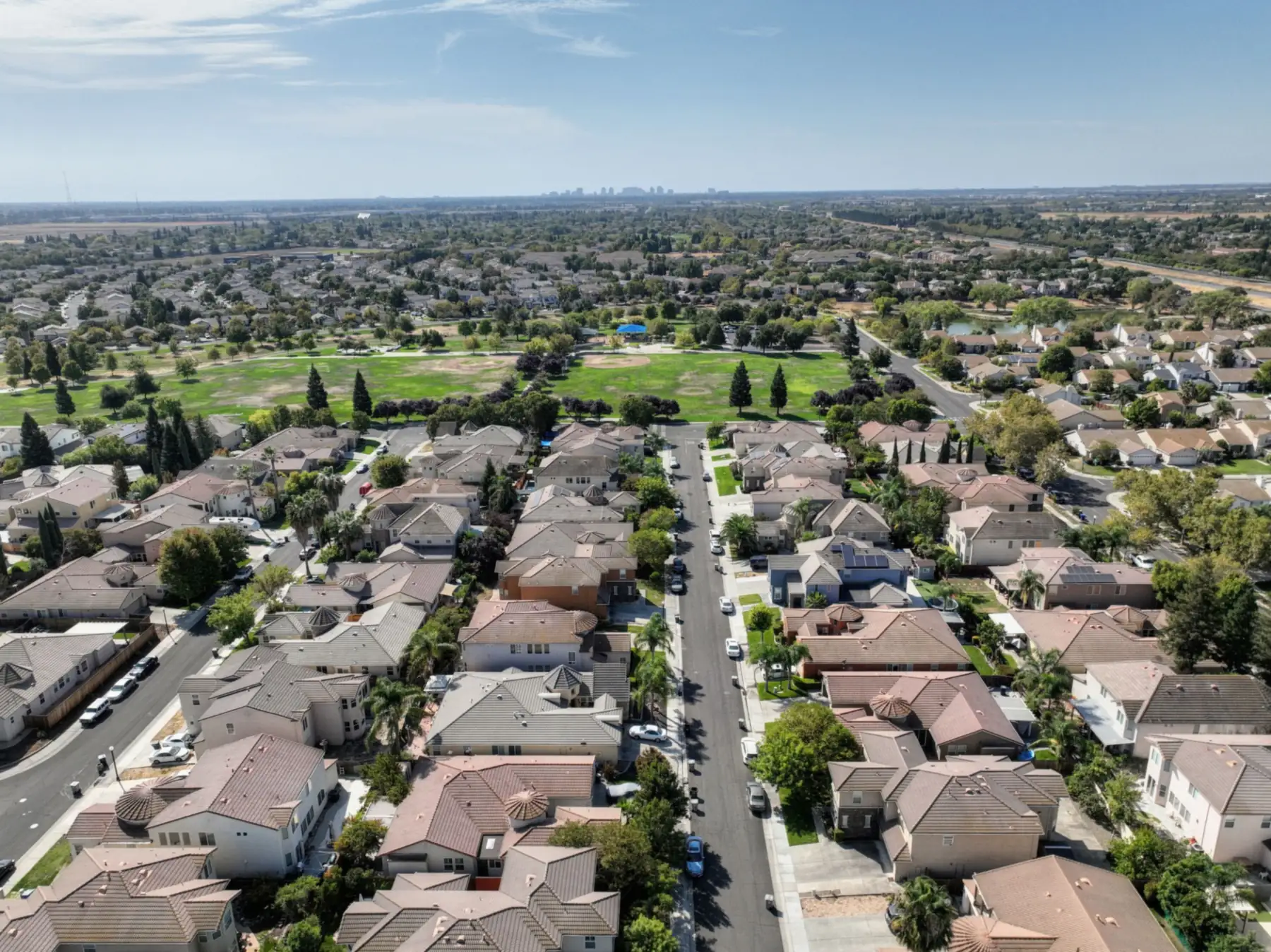
Nearly every roof in a photograph like this is the same age as the house under it. In Pearland, that is most of the story.
Pearland, subdivision by subdivision
A treatment restores flexibility to a shingle mat that is still intact. It cannot rebuild one that is finished. So the useful question is not “does this work,” it is “is my roof still young enough.” Here is roughly where Pearland stands. Your street may differ, and an inspection is what actually settles it.
| Neighborhood | Homes built | Typical status | What that usually means |
|---|---|---|---|
| Southlake | Built 2013-2020 | In the window | Roofs six to thirteen years old. This is the center of the range. |
| Stonebridge | Built 2006-2013 | In the window | Thirteen to twenty years. Many are right at the edge, which makes this the year to look rather than next year. |
| Shadow Creek Ranch | 2000s build-out | Depends | Mixed by section. Newer streets are in the window; the first phases are on borrowed time or already on a second roof. |
| Southern Trails / Riverstone Ranch | 2000s-2010s | Depends | Comes down to the street, and to whether the roof was replaced after a storm. |
| Silvercreek | Early 2000s | Depends | Original roofs are usually past the window. If yours was replaced in the last decade, it is squarely inside it. |
| Silverlake | Mid-1990s onward | Depends | Almost every house here is on roof number two, and roof number two is often exactly the right age. |
| Southwyck | Mid-1980s-1990s | Likely past it | Usually past it, unless the covering is much newer than the house. I will tell you which, in writing. |
If your roof is past the window, I want to be the one who tells you. Treating a roof whose mat has already failed is money set on fire, and it is the single most common complaint in this entire industry. You will get that answer in writing, with photographs, and I will not charge you for the trip.
What it does, and what it does not
The roof gets soft-washed first — low pressure, no blasting — because a treatment cannot soak into a surface it has to sit on top of. Plenty of outfits skip that step. Then the treatment puts the light oil fraction back into the shingle so the mat holds on to the granules it still has, and surface color evens out across the planes. It is soy-based and USDA Certified Biobased — that one is a real federal certification, not a slogan: application ID 10318, approved 9 November 2021, measured biobased content 98%. I have the notice and will show it to you. Two caveats I will give you unprompted: it is issued in the formulator's name rather than the brand on the tin, and USDA says it holds only while the formula is unchanged. One to three hours on site, and no tear-off. The lab numbers are further down.
Think of it as an oil change, not an engine rebuild. Texas sun bakes the light oils out of a shingle; the treatment puts a plant-based replacement back in. That helps a roof that is still sound and does nothing for one that is finished, which is why I inspect first.
On the day: before anything is sprayed, your plants, beds and concrete get wet down and kept wet, anything that could stain gets covered, and windows and dormers are shielded. Gutters and the perimeter are rinsed again at the end. Nobody needs to come inside.
It does not seal leaks — nearly all leaks happen at flashings and penetrations. It does not repair hail or wind damage, does not make a roof hail-resistant, does not kill algae, and does not reset your roof's age for insurance. It will not save a roof whose shingles are already curling, cracking or bald.
On insurance, plainly: Texas carriers rate a roof by its installation date, and most now use age-based actual-cash-value schedules. A treatment does not change the date on that file, and I will never tell you it does. What you get is a written, photographed condition report — a useful document for an insurer, a buyer, or your own records.
The sixty-second version
The lab numbers, and where they came from
This page used to carry a third number that the underlying report does not support. I have read the actual laboratory report now, cover to cover, and corrected it. Here is what the testing really found — including the part that did not go the way the sales material said it did.
| What was measured | Standard | Untreated → treated | What that actually means |
|---|---|---|---|
| Granule held onto the shingle | ASTM D3462 §8.1.9, per D4977 | 4.1 g → 0.3 g | The gutter-grit test: a weighted brush, fifty strokes. The untreated fifteen-year-old shingle shed 4.1 g and failed the one-gram limit a new shingle has to meet. Treated fifteen-year-old shingles shed 0.3 g and passed. A brand-new shingle sheds 0.2 g. This is the result worth caring about. |
| Water vapor passing through the shingle | ASTM E96 | 29.5 → 0.029 perms | Lower means less moisture moves through. The aged shingle was effectively open at 29.5; treated it measured 0.029, against 0.034 for the new shingle tested alongside it. Worth knowing: this test has no pass or fail mark, and a roof that breathes less is not automatically better — that is exactly the concern the roofing manufacturers' association raises about products like this one. |
| Pliability — whether the mat bends instead of cracking | ASTM D3462 §8.1.7 | No measurable change | Twenty specimens per set. Every set passed, treated and untreated alike — the lab's own note on the untreated fifteen-year-old shingles was that they “were flexible.” The sales literature claims this goes from 90% to 100%. It does not. I ran that number on this page for a week before I read the report, and I am not going to quietly delete it. |
Who ran these, and what they are not. The testing was done by a third-party building-products laboratory in Pennsylvania — not by me, and not by the manufacturer's own staff. But the manufacturer commissioned and paid for it, the manufacturer supplied the specimens already aged and already treated, and the lab tested them as labeled without verifying any of that. The report says in as many words that it is not a certification or an endorsement. Two or three coupons per test is not a roof, and none of it is a warranty. Ask me for the report number and I will give it to you.
Before & after
These are documented jobs from the manufacturer whose product I apply, shown with permission. Roof Shield's Texas work is just beginning, so I would rather show you somebody else's real roof, labeled honestly, than a stock photograph of nobody's. When yours is done, it goes here with your permission and not before.
The question everyone actually asks: does it stay that way?
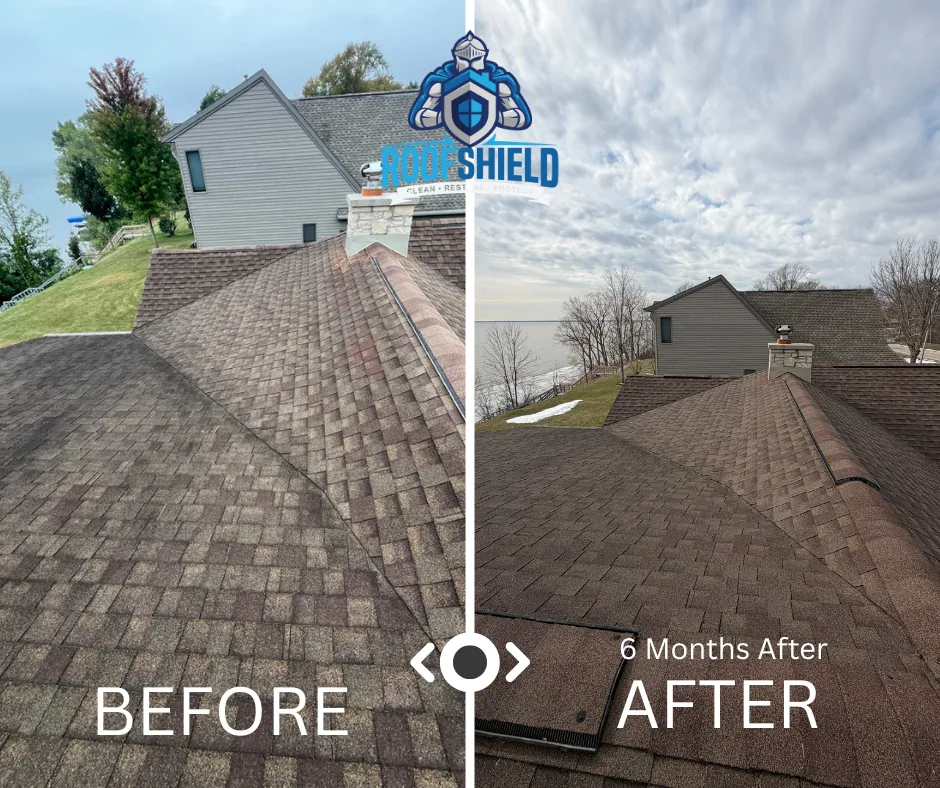
Ridge line — six months on
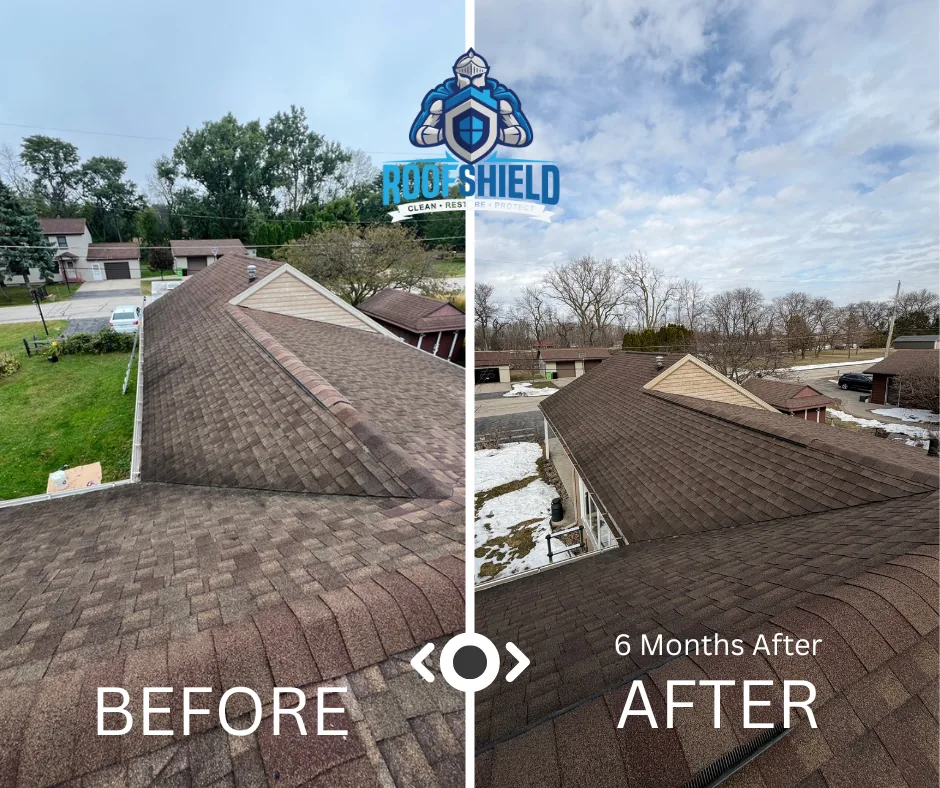
Same house, wider angle — six months on
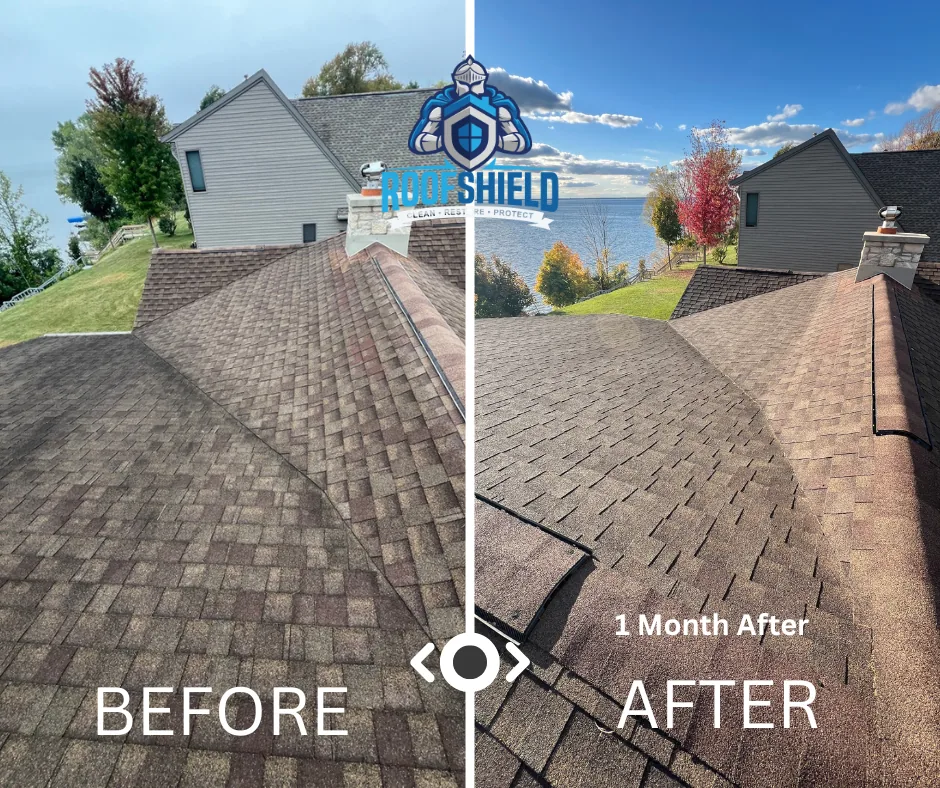
Same house — one month on
A fresh after-photo taken the same afternoon proves very little — any wet roof looks better. These were shot again a month and six months on, which is the honest version of the question, and it is why I picked them out of the pile. One more thing you should know: all three frames are the same house from three positions, not three separate jobs. I would rather say that than let three pictures do work they have not earned.
Where the difference is easiest to see
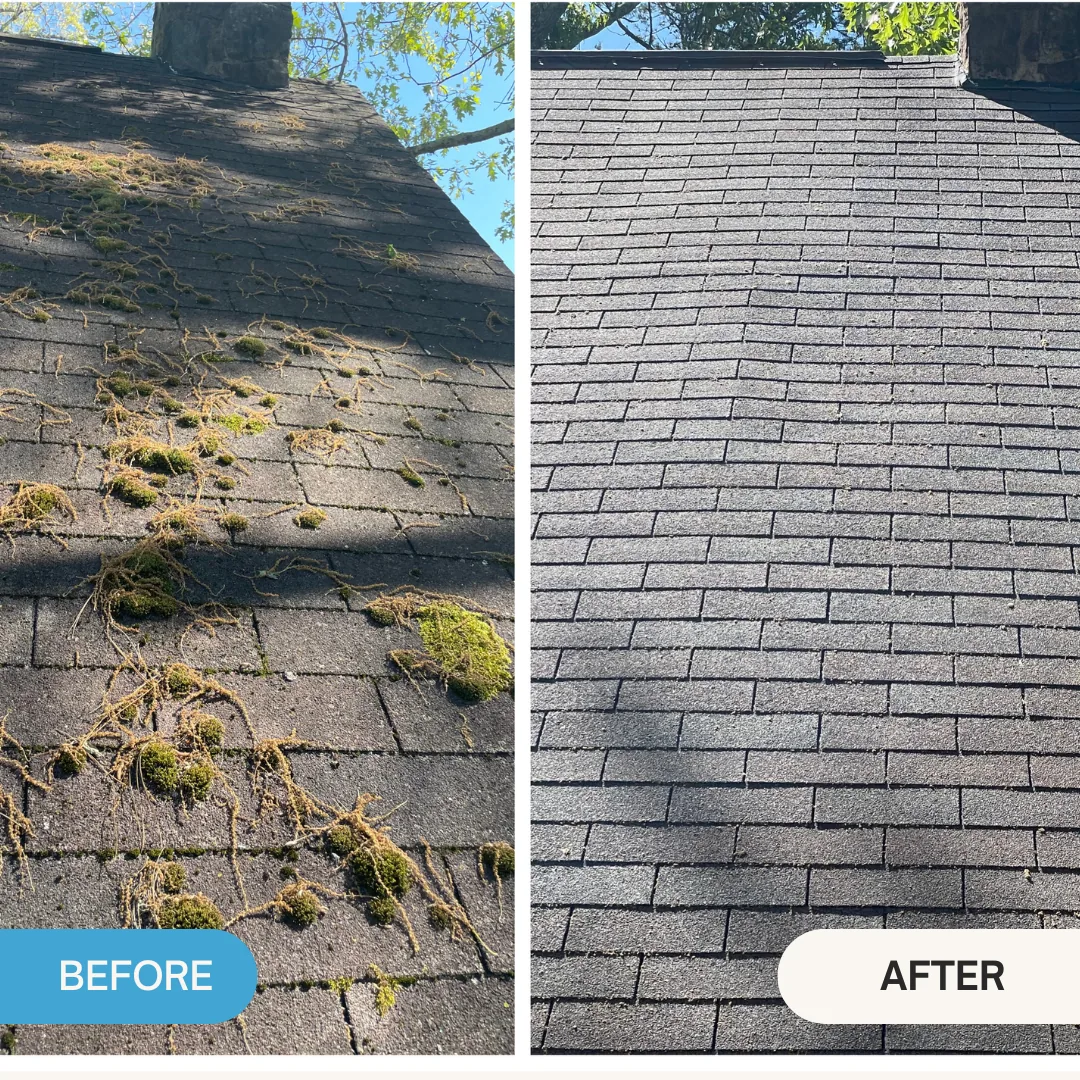
Soft-washed first — this is the cleaning step, not the treatment
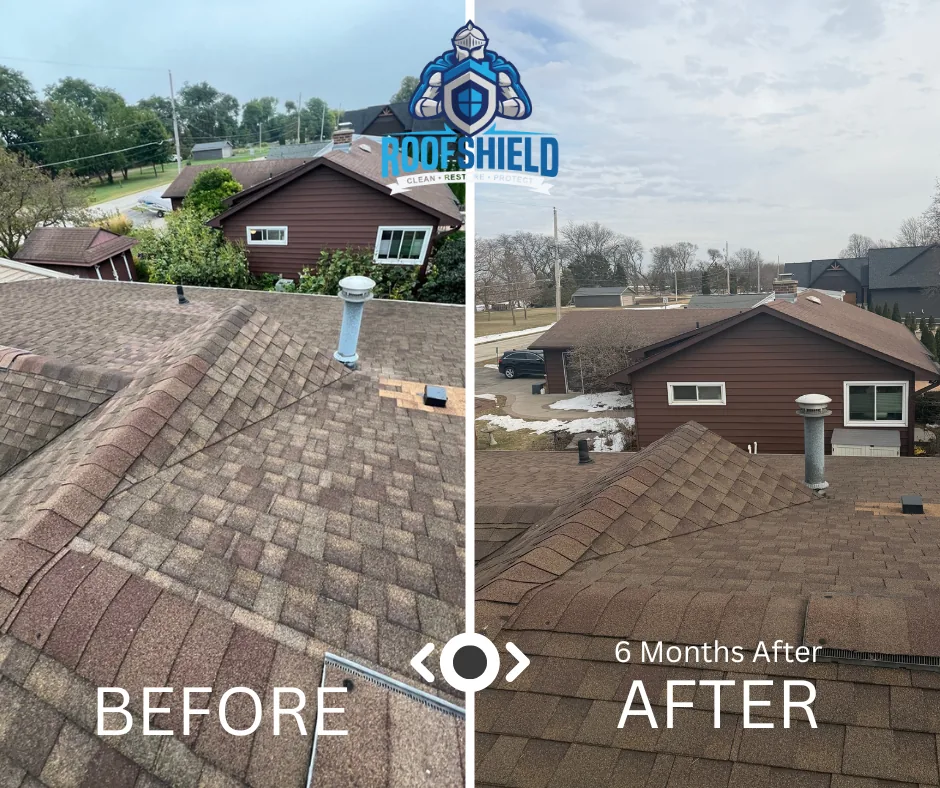
Close on the shingle — a different house, six months on
What you are actually looking at. Most of the visible change in a photograph like the left-hand one is the wash, not the chemistry — moss, algae and years of grime coming off. The treatment's real work is invisible in a photograph: it is the granule the shingle stops shedding. I would rather tell you which half of the picture is which than let you assume the oil did all of it.
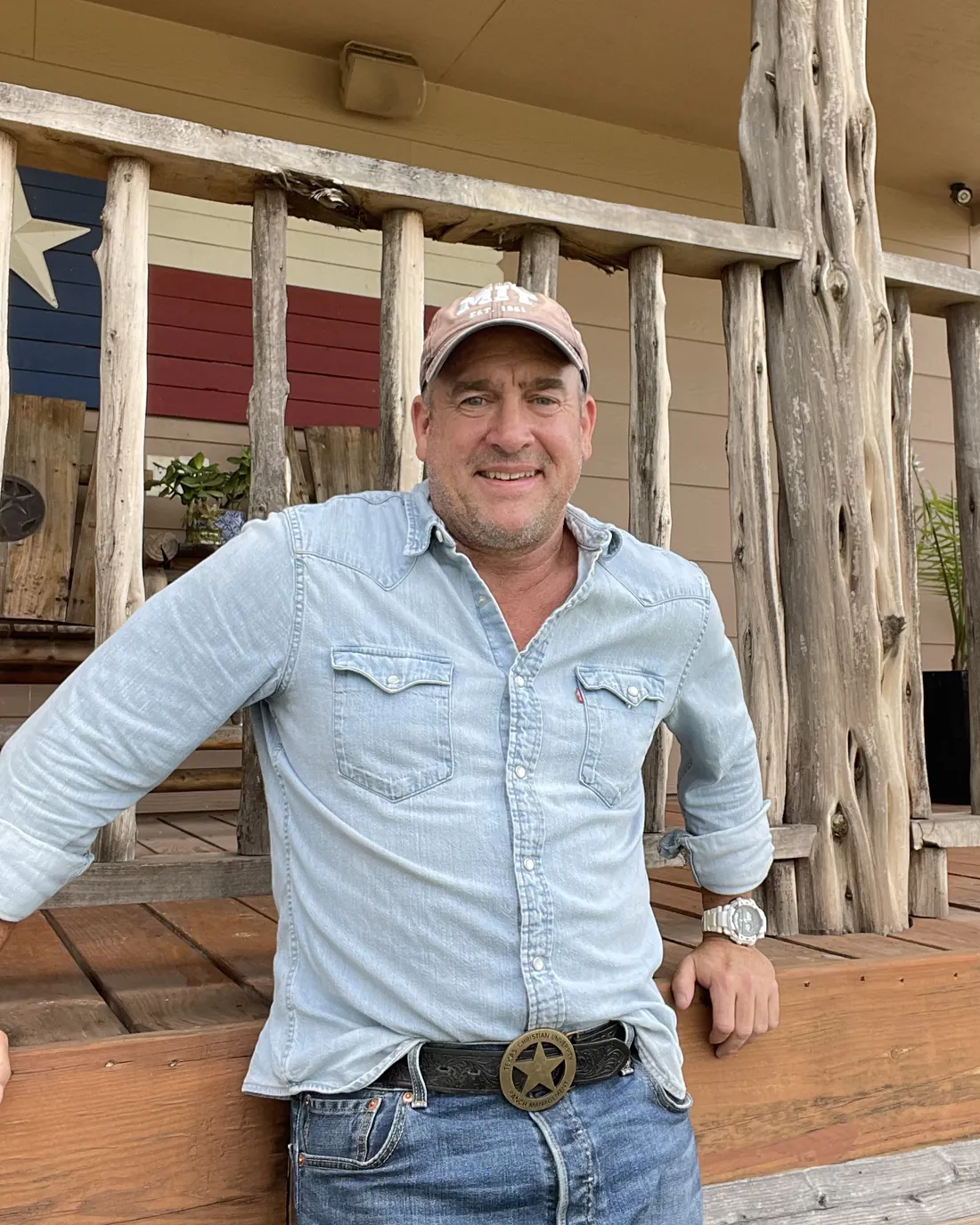
Who shows up
My name is Tres Curtis. My mother lives in Pearland, which is the honest reason I started here rather than somewhere with more houses and less meaning. When you call the number on this page, it rings my phone. When a ladder goes up against your house, I am the one on it.
Roof Shield is new in Texas and I am not going to dress that up. What I offer instead of a wall of reviews: a published price, a written report you keep whether or not you buy anything, a straight answer about whether your roof even qualifies, and a five-year written product warranty with its exclusions stated on the quote before you sign.
Straight answers
One dollar fifty per square foot of roof area, published, and it is the same number for every house on the street. A 2,000 square foot roof is about $3,000. A 2,400 square foot roof is about $3,600. You get your number in writing after the inspection, before you decide anything.
No, and anyone who tells you otherwise is selling you something. Texas carriers date a roof by its installation date, and a treatment does not change that date. What you do get is a written, photographed condition report on your roof, which is a useful document whether you are talking to an insurer, a buyer, or nobody at all.
No. Storm damage is a repair or an insurance claim, not a rejuvenation job. If the inspection turns up hail bruising, lifted tabs or wind damage, I will tell you that in writing and point you toward a claim or a repair crew. I do not offer to cover deductibles, and under Texas law nobody may.
Three things decide it: the age of the covering, whether the shingles are still lying flat, and how much granule is washing into your gutters. Roofs roughly six to seventeen years old with an intact mat are the candidates. Widespread curling, cracking or bald patches means the mat is finished, and no treatment brings that back. The free inspection tells you which one you have.
Less than the phrase “five-year warranty” makes it sound, so here it is plainly. It covers the flexibility of the shingles I treat, for five years from the treatment date, and it is prorated over sixty months — so a problem in year four is worth a good deal less than one in year one. The remedy is retreatment of the affected areas, and the manufacturer caps it at the cost of the service. It is not a warranty against leaks. It is fully transferable if you sell the house, with no restrictions. One practical thing: a claim requires photographs of the roof taken before treatment, which is part of why I photograph every roof and give you the file.
Because I would rather tell you what I cannot do than pretend otherwise. Roof Shield's Texas work is just beginning, so you will not find fifty five-star reviews here yet. The before-and-after photographs on this site are documented jobs from the manufacturer whose product I apply, shown with permission, and I say so rather than passing them off as mine. My price is published. My mother lives in Pearland. I am not hard to find.
Free roof inspection
Tell me where the house is and roughly how old the roof is. I will come look, photograph what I find, and hand you a written condition report — including the sentence “this roof is not a candidate” if that is what is true.
Prefer to talk? Call or text (713) 553-3225. I answer my own phone.
No obligation, and no sales appointment disguised as an inspection. I do not sell, rent or share your information. The performance figures on this page come from third-party laboratory testing commissioned by the product’s manufacturer; I rely on that report and will walk you through it at your inspection.